

Vuillaume Violins: History, Craftsmanship, and Pricing
Back to BlogVuillaume violins are among the most sought-after instruments in the world of fine string playing, crafted by Jean-Baptiste Vuillaume, one of the most remarkable figures in the entire history of violin making.
A master craftsman, Vuillaume built a virtual empire in Paris that would define French lutherie for generations and reshape the global trade in fine string instruments.
His Parisian workshop became the defining force in 19th-century violin making, training some of the greatest violin and bow makers of the era.
Among his over 3,000 instruments are copies of the finest Cremonese originals, so faithful that even Paganini could not distinguish Vuillaume’s replica of his own Guarneri Il Cannone by sight alone.
This guide explores the history and craftsmanship behind Vuillaume violins, what makes them so coveted by musicians, collectors, and investors today, and what to expect when buying one.
Who Was Jean Baptiste Vuillaume (1798–1875)?
Jean Baptiste Vuillaume is the decisive figure in modern French violin making. He is widely regarded as the most successful violin maker of the 19th century and, measured by pure business terms, arguably the greatest luthier in all of history.
His excellence lies across three dimensions: the extraordinary quality of his work, his creative and inventive spirit, and his remarkable business acumen.
Born in Mirecourt on October 7, 1798, into a well-established family of violin makers, Vuillaume moved to Paris in 1818 to work for François Chanot, who introduced him to innovative techniques for improving violin sound.
In 1828, he opened his own workshop at 46 Rue Croix des Petits-Champs, which quickly became the most important atelier in Paris and, within two decades, in all of Europe.
Vuillaume was equally an inventor. Among his many innovations: a large viola called the “contralto,” the three-string octobass (a massive triple bass), the hollow steel bow, and the so-called “self-rehairing” bow.
He also devised machines for manufacturing gut strings of uniform thickness, and famously inserted Stanhope optical lenses into the eyes of bow frogs.
During his whole life, he traveled extensively across Europe acquiring instruments, which allowed him to study and copy violins by the greatest Italian masters at close range.
How Many Violins Did Vuillaume Make?
Vuillaume made over 3,000 instruments in his lifetime. An astonishing output that included violins, violas, cellos, and entirely new instrument types of his own invention.
A large proportion of his output consisted of copies of the great Italian masters: Stradivari, Guarneri, Amati, and Maggini.
This volume of work, combined with their exceptional quality, cemented his legacy not only as the most prolific fine-instrument maker of his era but as a standard-setter whose influence shaped French lutherie for generations to come.
Notable players who have used Vuillaume violins.
Many notable players have used or owned Vuillaume violins, including Fritz Kreisler, Eugène Ysaÿe, Henri Vieuxtemps, Joseph Joachim, Ferdinand David, Charles de Beriot, Efrem Zimbalist, Toscha Seidel, Joseph Hassid, Isaac Stern, Arthur Grumiaux, Pinchas Zukerman, Andres Cardenes, Hilary Hahn, and Vilde Frang, among many others.
Characteristics of Vuillaume Violins
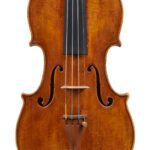
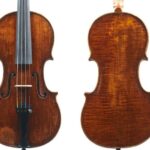
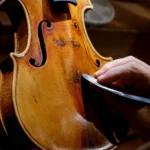
The vast majority of Vuillaume’s instruments are imitations of classical Cremonese pieces. He mastered the techniques for giving his instruments an aged appearance, with darkened wood and worn varnish, setting the standard for many other Parisian makers. One of the most obvious characteristics of his work is the wear pattern imposed into the varnish of the back, which is often in the shape of an inverted ‘V,’ with the thicker, colored varnish contrasting with the pale gray/gold color of the wood.
Vuillaume crafted such uncannily accurate copies of classical instruments that he soon acquired an excellent reputation as a luthier, amongst other things. It is said that Niccolo Paganini, who owned Guarneri’s ’Il Cannone’ violin, could not tell the difference between his instrument and Vuillaume’s copy of it when seeing them side by side. He could recognize the master instrument only after hearing subtle tone differences during playing.
Vuillaume always remained faithful to the essential qualities of the instruments he imitated, such as the outline and the arching. Some differences were sometimes the varnish’s color, the ribs’ height, or the instruments’ length. Vuillaume often chose a strikingly flamed single piece of maple for his copies instead of the understated two-piece backs of the originals. A particular instrument inspires some of his violins but is not necessarily a copy of that instrument. In his Amati copies, he often would carve a scroll more similar to Stradivari’s style, which reveals his preference for a cut at the last comma at the eye that stops at eleven o’clock rather than turning slightly further around at the end.
Vuillaume Violin Pricing
A certified, genuine Vuillaume violin in good condition can be worth between $150,000 and more than $500,000. Although there are many authentic Vuillaume violins on the market, there are also just as many fake ones, which is why it is extremely important to buy these violins from trusted sources and always ask for an appraisal of the instrument.
Of course, the price of an individual Vuillaume violin will depend on many factors, including its general condition, tonal qualities, whether it is a copy of a famous instrument, and its history (e.g., whether a famous musician played it, what period it was made in, whether an important person, etc. owned it).
Famous Vuillaume Violins
Several Vuillaume violins stand out as masterpieces of 19th-century lutherie, each with a remarkable provenance and story.
A Violin After Stradivari’s “Messiah” Model, Made in 1872 for Alard
This late-period Vuillaume exemplifies the highest standards of refined French violin making. It was commissioned by the celebrated violinist, professor, and Vuillaume’s son-in-law, Jean-Delphine Alard, as a gift for his colleague and dear friend, the violinist and composer Charles Dancla.
Alard asked Vuillaume to fit the instrument with a larger-than-usual label to accommodate a personal dedication: “From Alard to my friend Dancla. A friendship gift.” The violin was sold together with its original case from Charles Dancla’s personal collection, making it one of the most historically resonant Vuillaume instruments in existence.
A Decorated Violin, Part of a Quartet for the Duke of Caraman, Made in 1865
This extraordinary instrument was purchased directly from Vuillaume by Victor Charles Antoine de Riquet, the second Duke of Caraman, as part of a decorated string quartet.
Based on the Stradivari model and constructed from a single piece of strikingly flamed maple, it is widely considered one of Vuillaume’s greatest masterpieces. In 1988, it was offered at Sotheby’s, where it achieved a world-record auction price of £46,200 at the time.
A Violin After “Il Cannone” by Guarneri del Gesù, No. 1966, Made in 1854
This copy of Paganini’s legendary instrument features the characteristic blackening at the front of the violin and a wild, open scroll closely echoing the original.
In a personal departure from Guarneri’s style, however, Vuillaume opted for a single piece of dramatically flamed maple, quite unlike the understated two-piece back of the original Il Cannone.
In 1987, this violin was acquired by Hu Kun, a widely celebrated Chinese violinist and conductor.
A Decorated Violin After Stradivari’s “Ex-Stern” — “The Tsar Nicholas,” Made in 1841
This violin, based primarily on the Stradivari “Viotti” model, was made for Alexis Feodorovich Lvoff, a talented Russian violinist, conductor, and composer who served as adjutant to Tsar Nicholas I and was commissioned to compose Russia’s national anthem.
The instrument has been partially antiqued and features a coat of arms on its back with the inscription “God save the Tsar” and a white rose on the left. The coat of arms has attracted scholarly debate, as it appears connected to Tsar Alexander I, the predecessor of Tsar Nicholas I, rather than the tsar who commissioned it.
How Do I Identify a Vuillaume Violin?
Identifying a genuine Vuillaume violin requires expertise, careful examination, and ideally a certified appraisal from a trusted specialist. That said, there are several distinguishing characteristics that consistently mark his work.
- Varnish wear pattern: One of the most recognizable features is the wear pattern imposed into the varnish of the back, often in the shape of an inverted “V,” with thicker, colored varnish contrasting against the pale gray-gold tone of the exposed wood. Vuillaume mastered the art of giving instruments an aged appearance and set the standard for Parisian makers who followed him.
- Wood choice: Vuillaume frequently chose a single piece of strikingly flamed maple for the back, where the original Italian instruments he copied often used a more understated two-piece back. This is particularly visible in his Guarneri copies.
- Scroll carving: In his Amati copies, Vuillaume often carved a scroll more consistent with Stradivari’s style, specifically, a cut at the last comma near the eye that terminates at the eleven o’clock position, rather than continuing slightly further around. This subtle detail is a consistent stylistic signature.
- Outline and arching: Vuillaume remained faithful to the essential proportions of the instruments he imitated, the outline and arching are consistent with their models. Some variation may appear in varnish color, rib height, or overall length.
- Historical accuracy: Vuillaume’s copies were so uncannily faithful that Niccolò Paganini himself, when presented with his own Guarneri Il Cannone alongside Vuillaume’s copy, could not distinguish between them by sight alone. Only by playing both instruments could he detect the subtle tonal difference.
Because many fakes and misattributed instruments circulate on the market, always request a certificate of authenticity and appraisal before purchasing.
Notable Players Who Have Used Vuillaume Violins
Vuillaume violins have been played by some of the most celebrated violinists in history, which speaks directly to both their exceptional playability and their tonal quality.
Among the most notable:
- Fritz Kreisler,
- Toscha Seidel,
- Pinchas Zukerman,
- Andrés Cárdenes,
- Hilary Hahn,
- and Vilde Frang.
Vuillaume Violin Pricing
A certified, authentic Vuillaume violin in good condition typically ranges from $150,000 to over $500,000, depending on several factors:
- Condition — general structural integrity, varnish preservation, and any restoration history
- Tonal quality — how the instrument performs acoustically
- Model — whether it copies a famous instrument such as Il Cannone or the “Messiah” Stradivari
- Provenance — whether the violin has a distinguished ownership history, was played by a famous musician, or dates from a particularly refined period of Vuillaume’s output
Because there are as many fake Vuillaume violins on the market as genuine ones, it is critical to purchase from a trusted specialist dealer and always obtain a certified violin appraisal before completing any transaction.
Owning a Vuillaume Violin
The violin market has evolved considerably in recent decades, with ownership increasingly shifting from professional musicians to collectors and investors. Demand continues to grow worldwide, and well-documented instruments have appreciated consistently over time.
If you are considering investing in a Vuillaume violin, always research the seller thoroughly, insist on a professional appraisal, and request all relevant certifications.
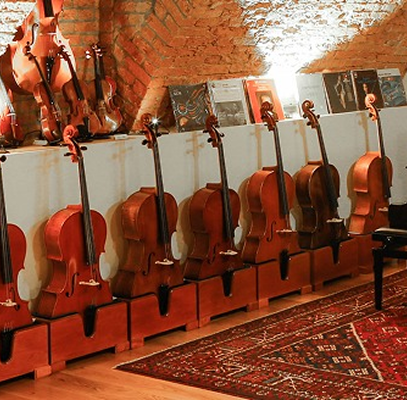
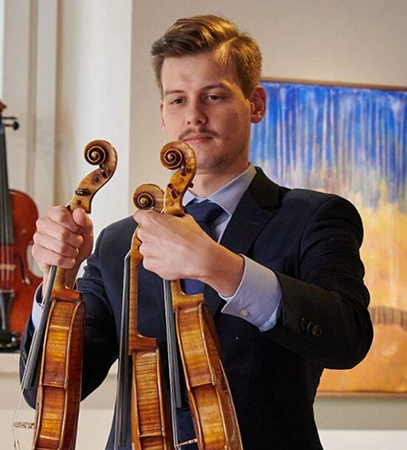
At Amorim Fine Violins, based in Cremona — the very city Vuillaume spent his life honoring through his copies — we carry that tradition forward through our curated collection of rare and historic instruments, each selected for its craftsmanship, provenance, and tonal quality.
Explore our Rare & Historic collection or contact our team to find your next instrument.